

Why Are There Orange or White Stains on My Siding and Brick Near the Sprinklers?
If you have noticed orange rust colored streaks or a chalky white haze on your siding, brick, or windows, and it always seems worst near where the sprinklers hit, your irrigation system is almost certainly the source. After a full summer of the system running, these stains are at their most visible right now. They are a common problem in the Raleigh area, and they are fixable, but not the way most people first try.
Here is what causes them and how to actually remove them.
What causes the orange stains on my siding near the sprinklers?
The orange or rust colored staining comes from iron in the water. A lot of homes in the Raleigh area, especially those on well water, have elevated iron content in their irrigation supply. Every time a sprinkler head sprays that iron rich water onto your siding, brick, or windows, the iron oxidizes as it dries and leaves a rust colored stain behind.
Because sprinklers hit the same spots over and over through the summer, the staining builds up in those exact areas. That is why the orange marks are always worst on the lower siding, the brick, and the windows closest to a sprinkler head.
What is the chalky white haze then?
The white haze is hard water staining, also called mineral or scale deposit. Irrigation water carries dissolved minerals, mainly calcium and magnesium. When the water sprays onto a surface and evaporates in the sun, the water leaves but the minerals stay behind as a chalky white film. Over a summer of repeated spraying and evaporation, that film builds into a visible haze, most noticeably on windows and darker siding.
So the two stains often appear together near the same sprinkler heads. The orange is iron, the white is hard water minerals, and both come from the irrigation water.
Why is it worst at the end of summer?
Your irrigation system has been running all season, spraying the same surfaces day after day through the hottest, driest months. Each cycle adds another thin layer of iron and mineral deposit, and the summer heat speeds up the evaporation that leaves those deposits behind. By late summer, after months of this, the buildup is at its heaviest and most visible.
This is why so many homeowners notice the staining now, at the tail end of the season, even if they did not pay attention to it earlier in the summer.
Why will not it just wash off with a hose?
Because neither stain is sitting loosely on the surface. Iron staining is an oxide bond, the same chemistry as rust on metal, and plain water does not break it. Hard water scale is a mineral deposit bonded to the surface as it dried, and it does not simply rinse away either. Spraying more water on it, which is essentially what the sprinklers have been doing, only adds to the problem.
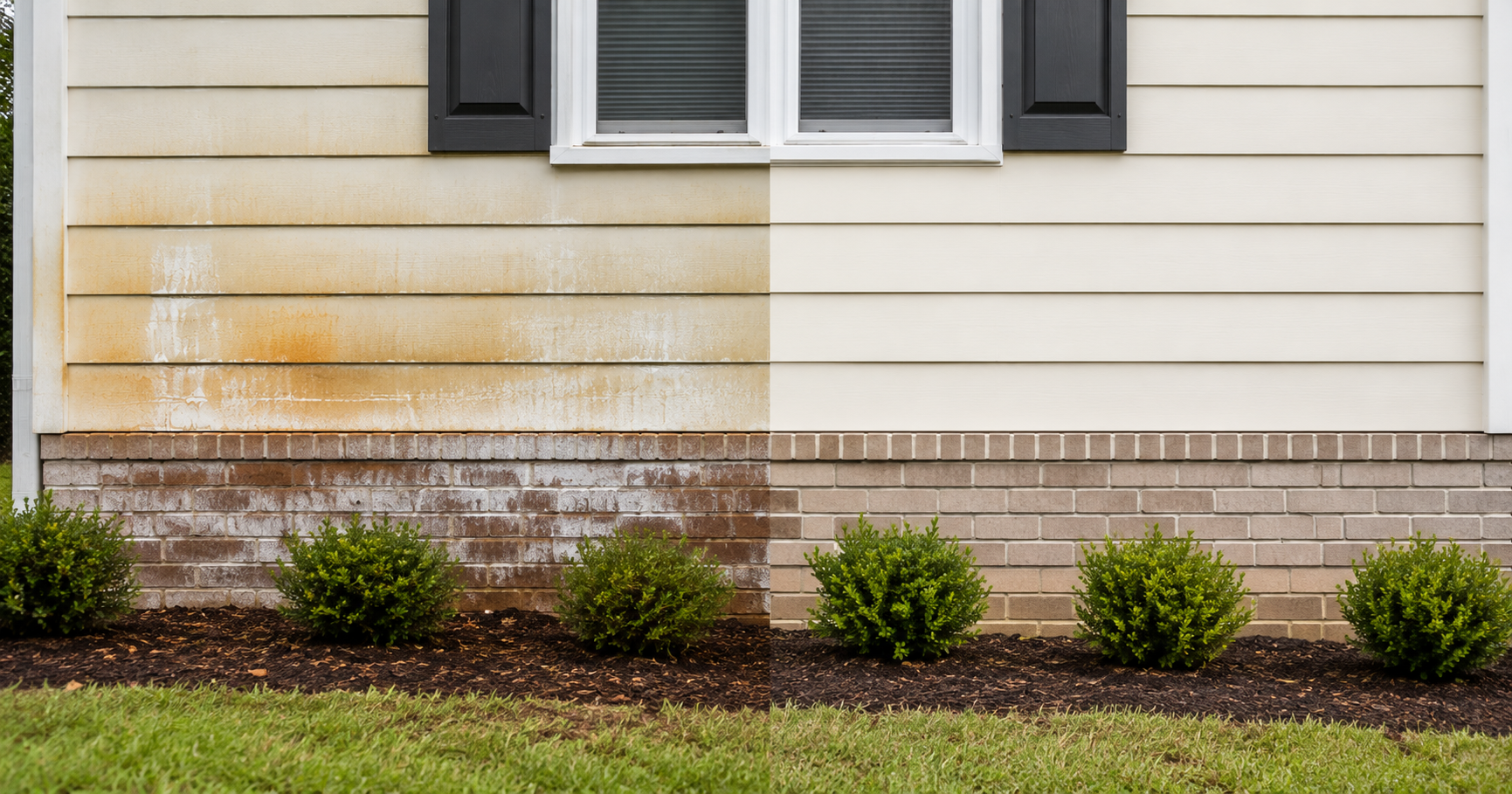 Removing these stains takes the right treatment. Iron and rust staining needs an acidic rust removal solution that breaks the oxide bond. Hard water scale needs a treatment formulated to dissolve mineral deposits. Standard pressure washing or a garden hose will not lift either one on its own.
Why does the source matter as much as the stain?
Because if you clean the stain but leave the sprinkler spraying the same spot, it comes right back within weeks. This is the part most people miss. The lasting fix is to treat the existing staining and adjust the source so it stops recurring.
Common source fixes include adjusting or repositioning sprinkler heads so they are not spraying directly onto the house, changing the spray pattern or angle, or in some cases adding a filter to the irrigation line to reduce iron content. We flag the likely source when we treat the staining so you can address it and not deal with the same problem next summer.
How do you actually remove it?
The process for irrigation staining on siding and brick is:
- Identify the affected areas and the sprinkler heads causing them
- Apply the appropriate treatment, an acidic solution for iron and rust, a mineral dissolving treatment for hard water scale
- Allow dwell time for the treatment to break the bond
- Rinse at controlled pressure suited to the surface, low pressure soft washing for siding to avoid damage
- Reassess and treat any heavier areas a second time if needed
- Note the source so the sprinkler issue can be adjusted to prevent recurrence
Is this a good time to have it done?
It is. The staining is at its most visible right now after a full summer of irrigation, and this week offers a dry window before the weekend rain and the cool down that follows. Getting it treated now clears a full season of buildup, and addressing the sprinkler source at the same time keeps it from returning next year.
If you are seeing orange streaks or a white haze on your siding, brick, or windows near the sprinklers, that is irrigation staining, and it takes the right treatment to remove rather than just more water. We serve Raleigh, Cary, Apex, Wake Forest, Garner, and the greater Wake County area.
Schedule Pressure Washing in the Greater Raleigh Area for rust and hard water stain removal, house washing, and exterior cleaning throughout the Triangle.
Learn more about our House Washing services at https://p2wash.com/residential/house-washing/
You can also explore our full Residential Pressure Washing services at https://p2wash.com/residential/
Get a Free Estimate or Book a Cleaning Today with P2 Pressure Washing. Call 919 893 3399.




