

If your driveway has orange-red staining along the edges, near the lawn line, or at the base of your downspouts, you’re dealing with something that doesn’t come off the way regular dirt does. Red clay staining on concrete is one of the most common calls we get across Wake County — and one of the most mishandled DIY attempts we see.
The problem is specific to this part of North Carolina. Wake County sits on a layer of red clay-heavy soil called Cecil soil — it’s what makes construction sites look orange and what turns every heavy rain into a rust-colored runoff event. When that clay-laden water hits your driveway, pools at the edges, and dries in the sun, it doesn’t just sit on top of the concrete. It bonds into the porous surface layer and oxidizes, leaving a stain that looks almost like rust.
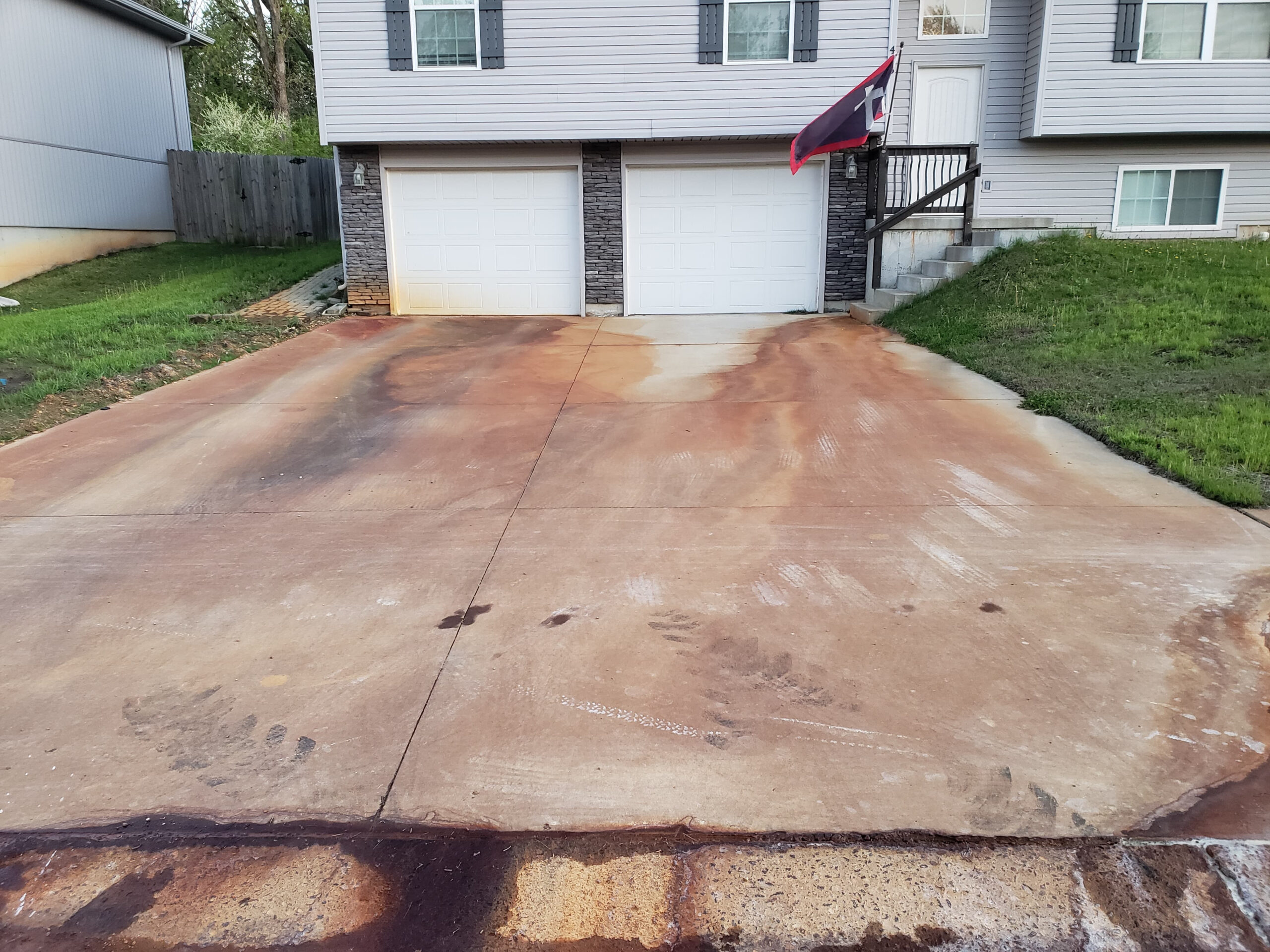 We see it on driveways all over the Triangle — especially in newer subdivisions in Apex, Fuquay-Varina, and Holly Springs where the lots were graded during construction and the lawn edges haven’t fully established yet, and in established neighborhoods in Garner and Clayton where heavy tree coverage keeps the soil wet and loose after every rain.
Why red clay stains are different from regular dirt
Regular dirt on concrete is surface-level — it sits in the texture and washes off with enough pressure and water. Red clay behaves differently because of its chemistry:
- Clay particles are extremely fine — much smaller than sand or silt — so they penetrate deeper into the porous surface of concrete
- The iron oxide content in Wake County red clay is what creates the orange-red color, and iron oxide bonds to concrete the same way rust bonds to metal
- Once it dries and oxidizes in the sun, the bond strengthens — each wet-dry cycle drives it deeper into the surface
- Standard pressure washing alone moves the loose top layer but leaves the bonded iron oxide behind, which is why the stain looks lighter after washing but never fully disappears
This is why homeowners who pressure wash their driveway after a heavy rain are frustrated when the orange tint is still there afterward. The pressure removed the loose material but didn’t break the clay-iron bond.
What actually removes red clay from concrete
The right approach requires a pre-treatment step before any pressure washing happens:
- Apply an appropriate cleaning solution — specifically one that contains an acid component capable of breaking the iron oxide bond. This is applied to the stained areas and allowed to dwell on the surface
- Agitate if needed on heavy staining — particularly on older stains that have gone through multiple wet-dry cycles
- Surface clean with a rotating surface cleaner — not a wand, which leaves uneven pressure and streaking. A flat surface cleaner gives consistent coverage across the full driveway width
- Rinse thoroughly and check for remaining staining — heavily oxidized spots may need a second treatment pass
The pre-treatment step is what most DIY attempts skip — either because homeowners don’t know it’s needed or because the right solution isn’t available at a standard hardware store. Without it, you’re just rearranging the problem.
Where red clay staining concentrates on most Raleigh driveways
Knowing where to look helps catch it before it sets in deep:
- Lawn edges along both sides of the driveway — where mowing and foot traffic keep the soil disturbed and rain carries clay onto the concrete
- Downspout discharge points — wherever a gutter downspout empties onto or near the driveway, concentrated clay-laden water hits the same spot every storm
- The apron at the street — where the driveway meets the road and runoff from the lawn crosses it
- Low spots and drainage channels — where water pools and deposits clay as it slows down and evaporates
- Near mulch beds — mulch holds clay-heavy soil and transfers it to adjacent concrete surfaces during heavy rain
The timing argument for getting it done now
After the wet spring Raleigh has had, red clay staining on driveways is at its most visible right now — weeks of rain have deposited layer after layer of runoff onto concrete surfaces that have had time to dry and oxidize between storms. The warm dry stretch coming this week and the 83-degree weekend on Saturday means that staining is baking in further every day.
Cleaning it now before summer heat fully sets in makes the job easier and the results better. Staining that’s been through a full summer is significantly harder to lift than spring accumulation.
If your driveway edges, downspout areas, or lawn line have that orange-red tint that won’t rinse away, we can clear it properly in one visit. Schedule Pressure Washing in the Greater Raleigh Area for driveway cleaning, red clay stain removal, and concrete surface cleaning in Raleigh, Cary, Apex, and Wake County.
You can also explore our full Residential Pressure Washing services at
https://p2wash.com/residential/
You can also explore our House Washing services at https://p2wash.com/residential/house-washing/
Get a Free Estimate or Book a Cleaning Today with P2 Pressure Washing.




