

If you stained your fence last year and it’s already going gray again — or you’ve stained it twice and it still looks washed out — the stain isn’t failing. The surface underneath it is. And in Raleigh’s summer heat, it happens faster than most homeowners expect.
This is one of the most common fence questions we hear, and the answer almost always comes back to one thing that gets skipped: the fence wasn’t clean before the stain went on.
Why does my fence turn gray so fast even with stain on it?
Stain needs clean, bare wood to penetrate and bond properly. When stain is applied over a fence that has mildew, algae, or oxidized gray wood fiber on the surface — even if it looks clean to the eye — it seals that biological layer in rather than bonding to the wood underneath.
The result is a stain that sits on top of the contamination rather than inside the wood. It looks good for a few weeks, then the mildew and algae beneath it continue to grow, the stain film breaks down from the surface up, and within a season the fence looks gray and worn again.
The gray itself comes from two separate things happening at the same time:
- UV oxidation — sunlight breaks down the lignin in wood fiber and turns it silver-gray. In Raleigh’s summer with UV index regularly hitting 10 or 11, this happens fast on any wood surface without active protection
- Biological growth — mildew and algae embedded in the wood grain turn dark gray or greenish-gray, particularly on the shaded sections and lower boards near the soil line
Does the type of stain matter?
Yes — but less than most people think. A high-quality penetrating oil stain applied correctly to clean wood will last 2–3 years. The same stain applied over contaminated wood may fail within one season. The preparation matters more than the product.
Water-based semi-transparent stains are more prone to surface failure in Raleigh’s humidity than oil-based penetrating stains, but neither performs well over a surface that wasn’t properly cleaned and prepped first.
What does proper fence prep actually involve?
This is where most DIY staining projects go wrong. Proper preparation before staining a wood fence requires:
- Professional cleaning first — soft washing or low-pressure washing with a cleaning solution that kills mildew and algae at the surface level, not just a rinse
- Brightener application — a wood brightener opens the wood grain and neutralizes the gray oxidation, allowing stain to penetrate properly. This step is almost always skipped in DIY prep
- Full dry time — wood needs to dry completely before stain is applied, typically 48–72 hours minimum depending on humidity. Staining damp wood traps moisture and causes premature peeling
- Application in the right conditions — not in direct midday sun at 98 degrees, which causes the stain to dry before it can penetrate
Should I clean my fence before restaining it?
Yes — every time, without exception. If your fence is gray, if it has any green or dark patches, or if it’s been more than a year since it was last cleaned, it needs to be cleaned and brightened before any new stain goes on.
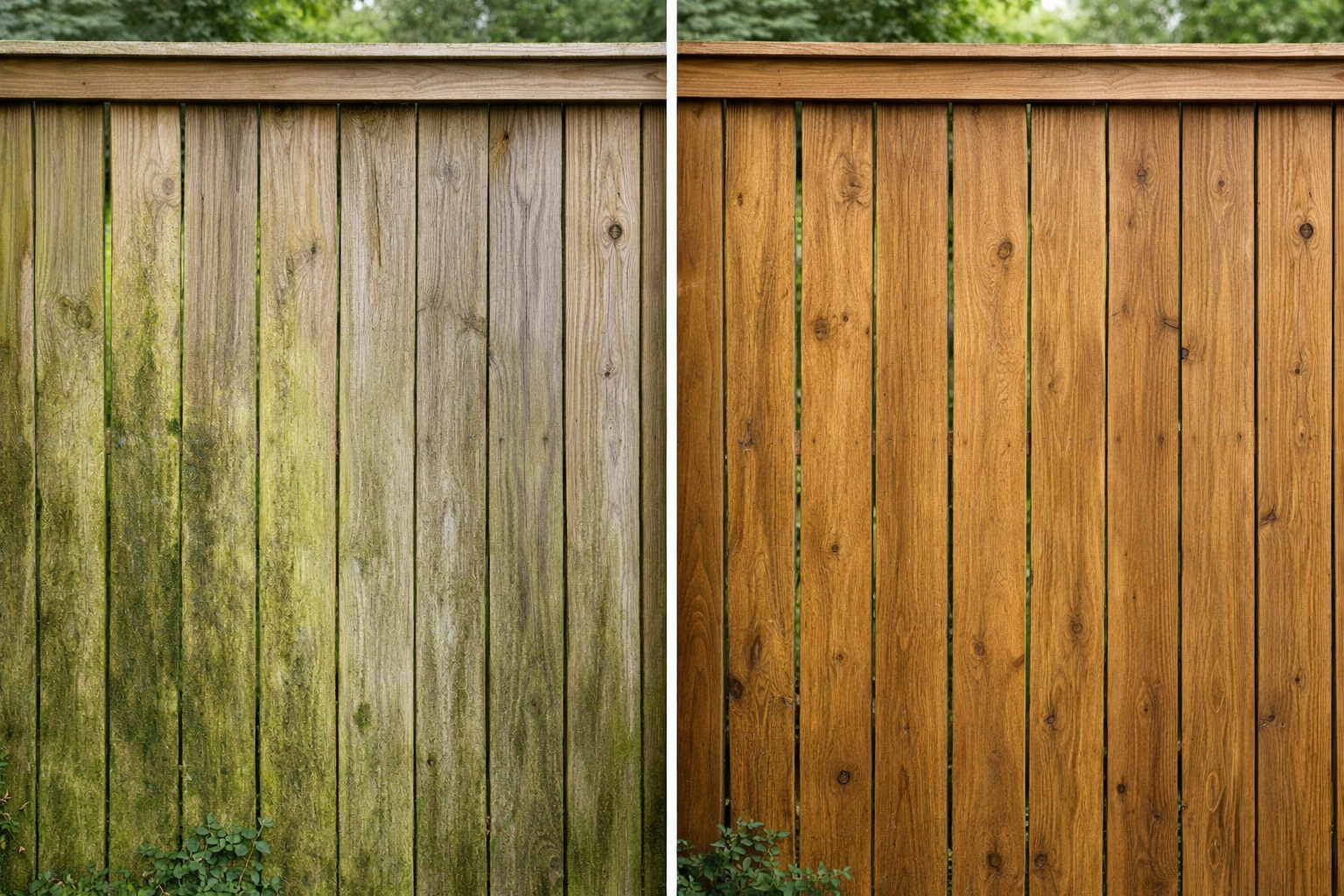 Applying stain over a dirty or gray fence is the single most common reason fence staining fails prematurely. It’s also the reason homeowners end up restaining every year instead of every 2–3 years.
Why does the bottom of my fence always look worse than the top?
The lower boards stay damp longer after rain and morning dew because they’re close to the soil line and shaded by the fence structure itself. In neighborhoods like Apex, Wake Forest, and Garner where lots have pine straw or mulch beds running along the fence line, the bottom boards sit in a consistently moist environment that accelerates mildew growth.
These boards also take the most splashback from rain hitting mulch and soil, which deposits organic debris directly onto the wood. They almost always need more cleaning attention than the upper boards.
What’s the right timing to clean and restain?
Late summer or early fall — after the worst of the heat but before temperatures drop below 50 degrees, which affects stain curing. In Raleigh that window is typically September through mid-October.
Right now in June is a good time to get the cleaning done. Letting the fence go into fall already clean means you’re ready to stain at the right time without having to wait for a cleaning appointment first.
If your fence has gone gray again after staining, or if you’ve been restaining every year and still not happy with how long it lasts, the cleaning and prep process is almost certainly the missing step. Schedule Pressure Washing in the Greater Raleigh Area for fence cleaning and exterior washing in Raleigh, Cary, Apex, Wake Forest, and Garner.
Learn more about our Residential Pressure Washing services at https://p2wash.com/residential/
You can also explore our House Washing services at https://p2wash.com/residential/house-washing/
Get a Free Estimate or Book a Cleaning Today with P2 Pressure Washing — (919) 893-3399.




