

If your deck feels slick underfoot even on dry days — especially in the shaded sections or near the steps — it’s not your imagination and it’s not the wood or composite material wearing out. It’s a thin layer of algae that’s invisible when dry but activates the moment any moisture hits it. Morning dew is enough.
With Raleigh hitting the low 90s this weekend and everyone heading outside, this is the time of year when deck slipperiness goes from a minor annoyance to a real safety issue — especially if you have kids, elderly family members, or guests using the space.
What makes my deck slippery if it’s not wet?
The slippery surface is a biofilm — a microscopic layer of algae that colonizes the deck surface and becomes dangerously slick the moment any moisture contacts it. You don’t need rain. Morning dew, humidity condensation, a spilled drink, or even bare feet coming from the grass are enough to activate it.
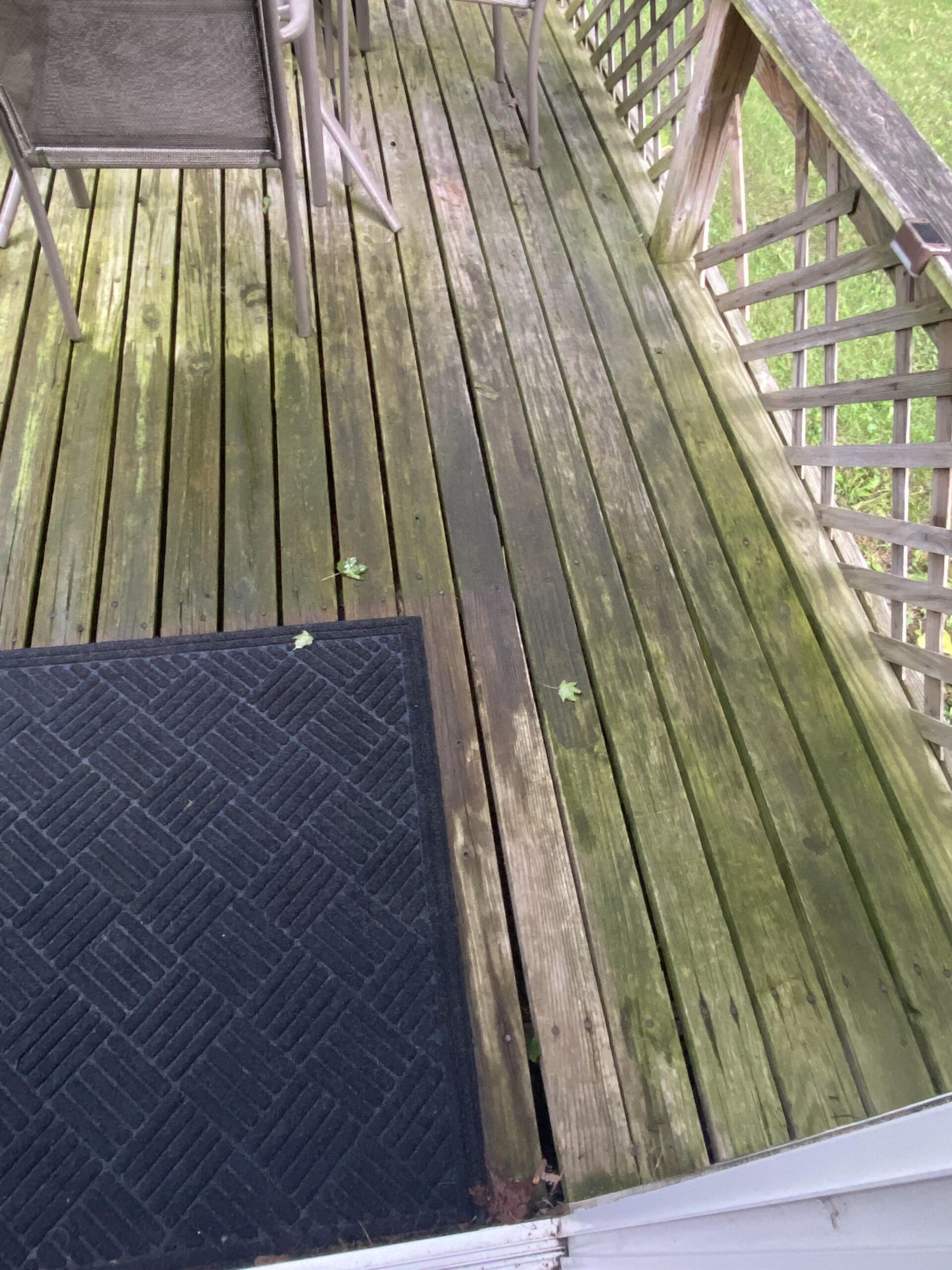 In Raleigh’s summer climate, this biofilm is present on almost every deck that hasn’t been cleaned since spring. The combination of warm temperatures, high humidity, and organic debris from surrounding trees creates perfect growing conditions from April through October.
Why does it happen more on certain parts of my deck?
The slipperiness isn’t usually even across the whole deck — it concentrates where the biofilm grows thickest:
- Shaded sections — any part of the deck under a tree canopy, pergola, or the shadow of the house itself stays damp longer and grows algae faster than sections in full sun
- Near the steps — the bottom of the steps and the landing area where foot traffic is heaviest and moisture collects is almost always the worst spot
- Between boards — the gaps between deck boards trap organic debris and stay damp, feeding algae growth that spreads to the board surfaces
- North-facing decks — a deck on the north or shaded side of the house may barely see direct sun all day and stays in growing-condition humidity constantly through summer
Does it matter whether my deck is wood or composite?
Both get slippery — but for slightly different reasons.
Wood decks absorb moisture into the grain and provide a porous surface where algae roots and spreads. The texture of weathered wood actually makes it more hospitable to biofilm growth than newer smooth wood.
Composite decks — Trex, TimberTech, and similar products — have a textured surface designed to feel like wood, and that texture traps organic material just as effectively. A lot of homeowners assume composite decks are low-maintenance and never need cleaning. They do. Algae on composite gets just as slippery as on wood, and staining that sets into composite over a full summer becomes harder to remove.
Can I just scrub it off myself?
Scrubbing with a brush and soapy water removes the surface layer temporarily but doesn’t kill the algae root system embedded in the deck surface. It grows back within a few weeks, usually faster the second time because the disrupted surface is more porous.
A pressure washer on a wood deck at high pressure raises the grain and leaves a fuzzy, weakened surface that actually traps more debris going forward. On composite, high pressure can pit the surface and void the manufacturer’s warranty.
The right method is a cleaning solution appropriate for the deck material — applied at low pressure with enough dwell time to kill the biological growth at the root — followed by a controlled rinse. That’s what produces a result that lasts through the season rather than a few weeks.
How do I know if my deck needs professional cleaning?
Check these three things:
- The step test — walk down your deck steps in bare feet or socks after morning dew. If any step feels slick, the biofilm is active
- The shade test — look at the shaded section of your deck versus the section in full sun. If the shaded area is noticeably darker or has a greenish tint, that’s algae
- The color test — if your deck boards have grayed significantly or have dark streaking in the grain, that’s a combination of UV oxidation and biological growth that scrubbing won’t fully address
Why should I clean it now before the rest of summer?
This weekend is forecast to hit 92 degrees in Raleigh — the hottest days of the year so far. Every hot humid day through summer is another growing cycle for the algae on your deck. Biofilm that’s been through a full summer is more deeply rooted and harder to remove than spring or early summer growth.
Cleaning now means you’re going into the peak of outdoor living season with a deck that’s safe and looks right, rather than dealing with it in September when the summer has done its worst to the surface.
Most deck cleaning jobs in the Raleigh area take 2–3 hours. The before and after difference — especially on a deck that’s been holding a season of green buildup — is one of the most dramatic results we produce.
If your deck has been slippery, green, or just looks tired heading into summer, now is the right time to get it sorted. Schedule Pressure Washing in the Greater Raleigh Area for deck cleaning, soft washing, and exterior cleaning in Raleigh, Cary, Apex, Wake Forest, and Garner.
Learn more about our Deck Cleaning services at https://p2wash.com/residential/deck-cleaning/
You can also explore our full Residential Pressure Washing services at https://p2wash.com/residential/
Cleaning Today with P2 Pressure Washing.




)
&description=&image=https://p2wash.com/wp-content/uploads/2026/06/Fix-your-slippery-Deck-P2-Wash-Raleigh-1024x779.jpg)